Showing posts with label Yugoslavia. Show all posts

Monday, 8 February 2021

Five Facts You May Not Know About The 1930 World Cup - Part 10

 @WC1930blogger

1. Each player upon arrival in Montevideo received a pinned badge from the World Cup organizing committee inscribed with the words ‘JUGADOR DEL CAMPEONATO MUNDIAL’. Made by the Milan based Stefano Johnson company it gave each player free access to Montevideo’s public transport (trams, buses, taxis), theatres and cinemas.

2. The Brazilians squad would struggle with Uruguay’s harsh winter conditions when they arrived in Montevideo. Their own winter was mild by comparison that you could find bathers on the beaches of Rio de Janeiro. On their World Cup debut against Yugoslavia on the 14th July the temperature had dropped between 5 and 6 degrees. During the match goalkeeper Joel’s hands were so stiff that Brazilian masseuse Ovid Dionysos, (nicknamed Jack Johnson because he resembled the black American Heavyweight champion) wrapped them in a towel with a hot water bag (bottle).

3. Bolivian center-half Diogenes Lara, a pioneer of football in Cochabamba, was a founding member of New Players FC. A lawyer by profession he was the lesser known brother of famous poet, novelist and journalist Jesus Lara Lara, whose literary works cast a light on the social issues of Bolivia’s indigenous population. 

4. Overzealous policing was heavily criticized by the nation's press for their handling of crowd control prior to Uruguay’s opening match with Peru on 18th July. Black market tickets and a failure to direct spectators to the assigned sectors caused overcrowding in parts of the Centenario. Police resorted to jabbing gestures with sabers to discourage encroachment on to the pitch by fans that included women and children.

5. The day after Uruguay defeated Argentina in the World Cup Final, the port of Montevideo was crowded with disgruntled Argentines. The Yugoslav delegation had booked their place on one of the ships heading to Buenos Aires with their luggage already loaded. When it came time to board there was chaos when a mass of several hundred angry Argentines rushed the staircase, some without tickets, led by a burly Argentine waiving two revolvers. It's not clear if he was the culprit of the gunshot that caused the captain of the ship to raise the ladder that left the Yugoslavs stranded without their possessions.


Sunday, 7 February 2021

Five Facts You May Not Know About The 1930 World Cup - Part 9

 @WC1930blogger

1. The Romanian team formed a choir among the players while on their travels to Montevideo. During the train journey through Italy they impressed the Italian passengers with a rendition of 'Giovinezza' the official anthem of Mussolini's National Fascist Party.

2. During Brazil's first training session at the Pocitos stadium one of their footballs was kicked over the wire fence and had fallen into the wasteland, where some local boys grabbed it and disappeared, before any them could reach it. Given that the ball was of little value, and the difficulty of identification in a working class neighborhood, delegation chief Afranio Costa resigned himself to the loss. As there were, however, a lot of people around the camp, he was very upset that no one helped. Days later, to the Brazilians great surprise, the ball appeared at their Hotel, sent by the chief of police, who in an attentive letter told us that he had learned of the fact by people who attended the incident, had ordered a rigorous search in the immediate vicinity, where they seized the ball for its return.

3. On the outskirts of the city of Montevideo after 6 pm stood many store fronts where could be found queues of men awaiting their turn outside the brothels in what was considered controlled prostitution. To the surprise of the leaders of the Yugoslav delegation they witnessed some of their players in the queue. Not wanting to cause a scene they waited until the next day to warn the team about the dangers of such proclivities.

4. During the Brazil vs. Bolivia match, French referee Georges Balvay stopped the game in the 8th minute unable to distinguish between the white shirts that both teams wore. The Bolivians changed into the sky blue jerseys of the Uruguayan national team. However, the talents of the Olympic champions did not rub off on the men from the Andean nation as they lost 4-0.

5. In the 77th minute of the Paraguay vs Belgium game, Lino Nessi, forward for the South American team clashed with the goal post when he tried to go for a rebound ball after a save from Belgian keeper Badjou. Knocked unconscious there were grave concerns for his health as he was led to the infirmary.

Monday, 14 December 2020

Five Facts You May Not Know About The 1930 World Cup - Part 8

1. Liverpool-born George Moorhouse, US left-back, attempted to sign England & Everton star forward Dixie Dean for his club the New York Giants while on a trip back home in 1928.

2.  Bolivian player Lieutenant Luis Reyes Penaranda was denied entry to Uruguay at the port of Buenos Aires on July 10th, due to issues regarding his visa. His four days travel by train from Bolivia had all been in vain. Denied playing for his country he brought honour to his homeland by fighting bravely during the Chaco War with Paraguay.

3. Several members of the Paraguayan squad arrived in Uruguay on the 13th July, the opening day of the World Cup. They had been on tour in  Peru and Chile with their club Olimpia. Paraguay would play their first game on 17 July, a 3-0 loss to the USA.

4. Brazil arrived in Uruguay with a team almost entirely made of Rio based players. This was due to a dispute with the Sao Paulo Federation who refused to send their players. After Brazil lost to Yugoslavia, it was reported in a Rio newspaper that the citizens of Sao Paulo rejoiced in their nation's defeat. This had been witnessed by the coach of Argentine team Huracan which was touring the city.

5. During the semi-final Uruguay were awarded a controversial goal against Yugoslavia. The Brazilian referee Rego had failed to see that a Police officer had kicked the ball back in to play from which the host proceeded to score. Yugoslav player Milorad Arsenijević assailed the gendarme and shook him by the throat. Later he was surrounded by police who tried to obtain his arrest.


Saturday, 12 December 2020

Five Facts You May Not Know About the 1930 World Cup - Part 7

@WC1930blogger

1. The French Football Federation defined the features of the insurance covering the delegates and the players travelling to the 1930 World Cup. It was decided that for the players and the officials who are married, the payment in the event of death will be increased to 100,000 francs. The daily allocation for all will be 30 francs, and the amount of the bonus will be 350 francs per person.

2. The Mexican press questioned the selection process of the 'National' team since all players were from the Capital but it was practical for these amateur players with their training camp at Parque Necaxa. All players arose at 6 am, trained till 8:30 followed by breakfast before leaving for their day jobs. Returned to camp at 5pm for lectures. Had dinner at 8pm before retiring to bed. 


3. US team manager W.R. Cummings, former Secretary to Robert Lincoln, son of Abe, described the field at Parque Central as '... being a bed of wet sticky clay with pools of water too numerous to count.' The US team strategy of using long wing passes was most effective in their opening day 3-0 victory over the short passing tactics of Belgium.


4. Brazilian forward Preguinho scored the first header in World Cup history in his nation's 2-1 defeat to Yugoslavia on 14th July 1930.

CORRECTION: After further discussion it was Bert Patenaude who scored the 1st headed goal in World Cup history (13 July) vs Belgium in the 89th minute in their 3-0 victory & not Preguinho (14 July, vs Yugoslavia.) Source: La Prensa (14/7/30)


5. Two Canillitas (newspaper vendors), both disabled, made a great sacrifice to watch Argentina play Uruguay in the World Cup Final. Alfonso Lloner and Antonio Pizzano left their home city of Rosario for Sante Fe where they crossed the river by raft to Parana. They made their way to Concordia and crossed Uruguay by train via Salto, Paysandu, Fray Bentos before finally arriving in Montevideo. 

Friday, 27 July 2018

Match Report - Uruguay vs Yugoslavia (English translation from El Sol)

@WC1930blogger

This is a match report of the second semi-final between Uruguay and Yugoslavia played on the 27th July 1930. The hosts 6-1 win over the Balkan state secured their place in the first-ever World Cup final against their arch-rivals and neighbours from across the River Plate - Argentina. 

This dispatch appeared in the Spanish newspaper El Sol, on the 28th of July. You can read the original report here.

Readers are welcome to offer their opinions on the translation to help with any improvements. The document was converted via google.


Uruguay, 6; Yugoslavia, 1

MONTEVIDEO 28 (10 m.). - Yesterday was the semifinal match of the world championship between the teams of Uruguay and Yugoslavia.

The first half ended with three goals to one in favour of Uruguay. From the first moment, the superiority of local players over their opponents was evident. However, the Yugoslavs produced a good impression, because they made excellent plays of short passes. His game during all this time recalled by its characteristics to the Argentine teams. In general, the game was animated and at times quite abrupt. The goalkeeper stood out remarkably from the Yugoslav team.

The Uruguayan front line was somewhat heavy. Their players did not demonstrate the excellent way in which they had acted in the match against the Romanian team. The defence acted well. The first goal of the afternoon was marked by the Yugoslavs. It was the only goal scored by this team, and it caused general confusion in the huge crowd that filled the stadium. The first Uruguayan, who gave the tie, was marked by Cea and received by the public with a formidable ovation. The second Uruguayan was scored by centre-forward Anselmo and gave rise to delirious expressions of enthusiasm, as well as the third, also achieved by Anselmo.

Shortly before the end of the first half the Yugoslavs scored the second goal, cancelled by the referee [for being] out of play.

In the second half, the superiority of the Uruguayan team became even more evident. As they were marking the many facts against the enemy goal the enthusiasm of the public overflowed. The match ended with six to one, in favour of Uruguay. The superiority of the local team was so obvious that most of the match was played near the Yugoslavian goal. Thanks to the magnificent performance of the Yugoslav goalkeeper, who played brilliantly, the Uruguayan triumph was prevented from reaching truly exceptional proportions.

In the Uruguayan team, the defenders Mascheroni and Nazzassi, the media Andrade and Fernández y Gestido stood out. The goalkeeper Ballesteros acted well, except in the goal that marked him at the start of the game. In contrast, the strikers did not produce a good impression and did not play up to what was expected. Only the left inside Cea and the centre-forward Anselmo stood out, although the game of the latter was inferior to the one played in the game played against the Romanians. In general, it can be said that from the technical point of view the game can be described as regular, and about more or less, similar to the one played between the United States and the Argentines the previous day, although the game played by the Yugoslav superior to the team of the United States.

So many Uruguayans in the second half had scored: one by Iriarte and two by Cea.

Throughout the meeting the order was perfect. The same as on the previous day, the authorities had taken extreme precautions on the outside of the stadium and on the inside of the stadium. The surveillance was in charge of police forces and armed soldiers. In order to prevent the public from invading the field, it was surrounded by a double woven wire fence three meters high.
The turnout was huge, it is estimated that more than one hundred thousand people attended the match, having exhausted the locations with enough anticipation. Thousands of people who had not been able to get places surrounded the field hoping to know the result. (Associated Press.)

The Olympic final of Amsterdam was repeated
 MONTEVIDEO 28 (11 m.). - With the victory of Uruguay with the same number as the Argentine team in their match against the United States, these two finalist teams are left to compete for the world championship. The finalist match between Uruguay and Argentina will be held on Wednesday.

Tuesday, 17 July 2018

Match Report - Yugoslavia vs Bolivia (English translation from El Sol)

@WC1930blogger

This is the English translation of the match report that appeared in the 18th July issue of Spanish newspaper, El Sol, from 1930 of the Yugoslavia vs Bolivia game that was played at the Estadio Gran Parque Central, home of Montevideo based team, Club Nacional, that was played on the 17th July.

The author of the article is anonymous but was written by a journalist working for Associated Press and is most likely a South American reporter on location in Uruguay.

Google was used to translate this document and is, therefore, subject to possible errors that would be better crafted by a professional translator. Spanish speakers are welcome to offer their opinions to help improve the text. You can read the original report here.


The victory of Yugoslavia, over Bolivia
MONTEVIDEO 17 (12 n.).
At the meeting held this afternoon between the national teams of Yugoslavia and Bolivia, Bolivians began attacking strongly to their opponents and putting constantly threatens the Yugoslavian goal only due to the brilliant performance of their goalkeeper was not crossed by the Bolivian shots.

The Yugoslavs, faced with such continuous attacks, were forced to stay defensive at all times.

This dominance of the players of a Bolivia was maintained throughout the first half, but the referee marked the end of the period without either side having scored so much.

In the second half, the Yugoslavs begin a brilliant attack, which takes completely surprise to their opponents. The game is developed in inverse form to that of the first half. The Bolivian goalkeeper shows a lack of security and the whole team reveals that it lacks defensive technique. In these circumstances, the Yugoslavs mark four goals and undo all the Bolivian attacks, which were so brilliantly developed during the first half of the fight.


At the beginning of the match, the Bolivians surprised the public with an effective game, which always kept the ball in Yugoslav territory, to the point that in the minds of all the spectators was the belief that they would win. But a few minutes into the second half, the Bolivians began to waver and Yugoslav domination prevailed.

The Bolivian team played most of the game with ten players because the player Gomez had to be removed from the field with a fractured leg within minutes of having started the first half.

Monday, 2 April 2018

Match Reports: Yugoslavia vs Brazil & Romania vs Peru (English translation of Heraldo de Madrid)

This is an English translation of the match reports that appeared in the Spanish newspaper, El Heraldo de Madrid, on 15th July 1930. The two authors are anonymous but most likely are South American journalists. El Heraldo de Madrid did not send a correspondent to Uruguay and, based on previous dispatches, most likely carried the reports published by the cable news agency Associated Press.
Google was used to translate this document, and I have tried to keep to this conversion, but where there is confusion, I have added my interpretation. 
The identity of some players described in the action may not be correct as other reports identify different players. This is due in part because the players did not wear shirt numbers. 
What is common in much of the Spanish language press is the difficulty in their spelling of the names of the Yugoslav players. In this instance, I have decided to the include the misspellings.
You can read the original match report in Spanish here.
El Heraldo de Madrid, on 15th July 1930.
The soccer world championship in Montevideo
MONTEVIDEO 15. - The matches between the national teams of Yugoslavia and Brazil on the one hand, and Peru and Romania on the other, have been played in different fields and at the same time.*
*This is not correct. The Romania - Peru match was played after Yugoslavia - Brazil.
The Brazilian team was aligned in the following way:
Monteiro; Brilhante, Gervazoni; Fonseca, Dos Santos, Giudicelli; Ribeiro, Murtinho, Patuska, Coelhi and Bethencourt.
The Yugoslav team was composed of Yakchitch; Yocovitch, Michailovitch; Arsiniyovitch. Stevanovitch, Djokitch; Tirnanitch, Meryanovitch, Becb, Vonyadinovitch and Sekoulitch.
During the first half the Yugoslavs scored two goals in the twenty-three and thirty minutes of play, although the Brazilians showed to have a better technique.
The fight took a great train (tren) (?), playing the teams with violence. The referee annulled another marked (goal) by the Yugoslavs, for having been made out of play (alternative translation: for having been offside).
In the second half the Brazilians made superhuman efforts to draw; but they could only do so much, finishing the game with the victory of the Yugoslavs by two goals against one.
The match between the Romanians and Peruvians was developed in the following way:
At first the Romanians showed great superiority over their opponents, although they play with enthusiasm; but all their efforts are crashing before the Romanian defense line.
The minute after the start of the game the Romanian striker Covaci throws himself on the opposite goal and shoots a strong shot that stumbles on the head of the Peruvian goalkeeper, and this same one introduces him into his net, thus marking the first goal for the Romanians.
At thirty-eight minutes of play the Peruvian De las Casas and the Romanian Stainer stumble, resulting in the European player with a fractured leg. The game is suspended for ten minutes.
The first half ends with the result of 1 to 0 in favor of Romania.
At the beginning of the second half the Peruvian player Galindo and the Romanian Covaci got stuck (alternative translation: Galindo hit Covaci). The referee expelled Galindo, playing from this moment both teams with ten players.
The fight continued with monotony: but at thirty minutes the Peruvians Souza tied the score somewhat.
Three minutes before finishing Romanian put (scored) a goal, and two minutes later hit the Peruvian goalkeeper (goal) again, ending the meeting with the score of 3 to 1 in favor of the Romanians.

Wednesday, 27 December 2017

The Descendants - Oral Testimonies (Part-1)

@WC1930blogger

Eighty-seven years have passed since the first World Cup was played in Montevideo, Uruguay. The footballers that played in 1930 have since passed away and we can no longer speak to them to offer their recollections of a tournament where very little film footage exists. 

The next best thing is the stories and experiences that were passed on to their relatives and recorded by historians, writers, journalists and filmmakers. While such eyewitness evidence, passed on by word of mouth, can present problems of faded memories and biased interpretations, such oral testimonies are 'not necessarily any more biased or partial than documentary evidence.' 

Here, then, is a collection of such testimonies from the descendants of those men that had the honour of playing in the 1930 World Cup. It includes links to articles, videos and audio recordings from their wives, sons and daughters to their nephews and grandchildren.

Bert Patenaude was only 20 years old when he played for the United States in 1930. The Fall River Marksmen striker scored four goals in Montevideo, scoring in the first game against Belgium on 13th July and then four days later the first hat trick in World Cup history against Paraguay. His wife, Leona Lambert, who passed away early this year at the age of 103, gave an interview with Fall River's Herald News in July 2010. Bert's son, Bert Patenaude Jnr, also gave an interview in July 2010 with ESPN.

James Brown was born in Scotland in 1908 and was one of six British born players to represent the United States in Uruguay. He is credited with the lone US goal in their 6-1 defeat to Argentina in the World Cup semi-final. His son, George Brown, who also played for the United States in a World Cup qualifier in 1957, gave an interview with the UK's Daily Mail in September 2017. George also appeared in a documentary Soccer in the New World - Part 1 - The history of Soccer in North America, where he recalls a story related to him by his father of the United States victory over Belgium.


Arnold 'Arnie' Oliver was a forward with the 1930 United States team that travelled to Montevideo, Uruguay, but did not play in any the World Cup matches. However, he did play in several exhibitions as apart of post World Cup tour. In 2002, his daughter, Jane Britto, was interviewed by New Bedford's Standard-Times, which appeared on their website Southcoasttoday.

Robert 'Bob' Millar was the coach of the US team in Uruguay. Born 1890 in Scotland, he played for two seasons with Scottish club St Mirren between 1909-1911 before emigrating to the States, where he played for more than a dozen American teams and won several titles. He went on to coach the New York Giants where he was given the opportunity to take charge of the US national team in Uruguay, where he led them to the semi-finals. In 2014, during the United States moderately successful World Cup campaign, an Oregan based TV crew from KGW News, tracked down his daughter Mary Martyn in Gresham. The interview is no longer available to watch but a transcript of the news item is archived here.

Andrew 'Andy' Auld, like James Brown, was also born in Scotland, in 1900, and played for the US team in Montevideo. A World War One veteran, Andy emigrated to the States in 1923, with the intent of settling in Gillespie, Illinois. When his plans did not work out as he hoped he went to live with his sister in Niagra Falls. It was while playing for local team MacKenzie F.C. that he was spotted by a recruiter for the new ASL team Providence Clamdiggers where they offered him a professional contract. In later life, Andy would return to Scotland to visit his relatives, and in 2002, his nephew, Bobby Auld, gave his recollections about his uncle to the Scottish newspaper, The Herald.

Adalbert Steiner was a defender who played for Romania in their 3-1 victory over Peru in their opening World Cup match. He was born in 1907 in Temesvar (Timisoara) at a time when the region was apart of the Austro-Hungarian empire. Steiner had a successful period with Chinezul Timisoara winning several titles before moving to Clubul Atletic Timisoara where he was picked to play for the national team in Montevideo. Early in the game against Peru, Steiner suffered a double fracture leg break after a vicious tackle by Peruvian Souza Ferreira. For those versed in the Romanian language check out the audio interviews with Adelbert Steiner's two sons, Iosif and Adelbert, recorded with Radio Timisoara, on the 25 June 2015 and the 5 July 2015, as they discuss their father's experiences in Uruguay.

Ladislau Raffinsky was a Romanian forward who was apart of the Romanian squad that travelled to Montevideo in 1930. In 1929 he scored ten goals for Juventus Bucharest in their 16-0 victory over Dacia Urinea Brailia. Raffinsky, along with his teammate Emerich Vogl, initially had trouble seeking time off work to go to the World Cup. In 2015, his daughter, Colceriu Rodica, gave an interview with news publication Actual de Cluj, about her father. The article which details his journey and experiences in Uruguay is drawn largely from the journal of Romanian captain Rudolf Wetzer.

Dragomir Tosic was part of the Yugoslav squad at the 1930 World Cup although he did not get a chance to play in any of the matches. Dragomir wrote letters home to his parents about his journey and experiences during this epic tour to South America. Unfortunately, all but one of these letters were destroyed in World War Two after a German bomb hit the home of his parents. In 2012, his daughter-in-law, Milica Tosic, wrote a biography of his life titled „Jedno Pismo, Jedan život...” ("One Letter, One life ..."). For Serb speakers, you can listen to an interview that Milica Tosic gave to Radio Beograd in 2013 about the book.

Dr Mihajlo Andrejevic was Secretary of Foreign Affairs of the JNS, the Yugoslav Football Federation. He was head of the Yugoslav delegation that travelled to Uruguay in 1930. He wrote correspondence that he dispatched to the Belgrade newspaper, Vreme, reporting on the Yugoslav team in Montevideo. In 2011, his son, Milan Andrejevic, was interviewed by Serbian newspaper, Politika, where he recalled the time his father left for South America.

Kosta Hadzi was a lawyer from Novi Sad and Vice-president of the Yugoslav Football Federation. He travelled to Montevideo in 1930 as part of the Yugoslav delegation. In 2010, the Serbian newspaper, Politika,  interviewed his son about his father's life and his time in Uruguay.

Milovan Jaksic was the goalkeeper for the Yugoslav national team that travelled to Montevideo in 1930. He was instrumental in Yugoslavia's 2-1 victory over Brazil in their opening World Cup match, where he made many fine saves. The Uruguayan newspapers praised his performance and immortalised him in print and photographic poses in their pages proclaiming him 'El Gran Milovan'. In 2014, his niece, Gordana Jaskic, gave two interviews to the Serb publications, Novosti and Kurir, where she provided an account of his early life.

Blagoje 'Mosa' Marjanovic was an inside forward for the Yugoslav national team that took part in the first World Cup. He was top-scorer for his club BSK Belgrade in 1930, and he would score in his country's 4-0 victory over Bolivia. He was one of the first professional footballers in Yugoslavia along with his teammate Aleksander Tirnanic. In 2013, his son Zoran Marjanovic gave an interview with the Serb newspaper Novosti, describing his father and his life. For Serb speakers, you can also watch an interview with Zoran Marjanovic and his sister, Visnja Marjanovic, discuss the life of Mosa for Serb television in 2011 with RTS.


Guillermo Stabile was the top goal scorer at the 1930 World Cup for Argentina. A prolific striker for his club, Huracan, he only made his debut for his country against Mexico when Roberto Cherro fell ill and Manuel Ferreira had returned to Buenos Aires to take a law exam. His hattrick in that game secured his place in the team for the rest of tournament. He would score twice against Chile in a 3-1 win which assured Argentina's place in the semi-final against the United States. His two goals against the Americans in a 6-1 rout saw Argentina reach the final against their fierce rivals Uruguay. Stabile would score his eighth goal in that final to give his team a 2-1 lead before half-time, but it wasn't enough to win the game as the host ran 4-2 winners. An excellent article on fifamusuem.com details his life and career with some added anecdotes from Stabile's grandchildren, Guillermo, Estaban and Roxanna.

Luis Monti was the legendary midfielder for Argentina at the 1930 World Cup known for his physical prowess. He scored the only goal, from a freekick, for his country in a 1-0 victory over France in their opening game. He sat out Argentina's next game, a 6-3 win over Mexico, for reasons not entirely clear, but returned to help Argentina beat Chile 3-1. He scored the opening goal against the United States in a 6-1 victory in the semis but had decided he would not play in the final against Uruguay because of death threats to his family. He was finally convinced to play in that game but did not give his usual physical performance with Argentina losing 4-2. He would later play in Italy and represent his adopted country at the 1934 World Cup where he helped them to a 2-1 victory over Czechoslovakia in the Final. Read another great article on fifamuseum.com about his life and an interview given by his grand-daughter, Lorena Monti.

Oscar Bonfiglio was the goalkeeper for the Mexican team that travelled to Montevideo in 1930. He played against France in one of two opening games of the tournament and conceded the first ever World Cup goal by Lucien Laurent in a 4-1 defeat. He was dropped for Mexico's next game against Chile, another defeat (3-0), but returned for the last game against Argentina where he conceded six goals. He did, however, save a penalty from Argentina's Fernando Paternoster. In 2014, his grandson, also named Oscar Bonfiglio, gave an interview with ESPN Deportes about his grandfather.

Juan Carreno was a legendary forward for Atlante and the Mexican national team and travelled to Uruguay in 1930. He scored in Mexico's 7-1 defeat against Spain at the 1928 Amsterdam Olympics and would score Mexico's first goal at a World Cup in their 4-1 loss to France. For those versed in the Spanish language, you can watch a Mexican TV program with interviews with Juan Carreno's daughter, Guadeloupe Alicia Carreno, grandsons, Victor Molina Carreno and Julio Molina Carreno, and granddaughter, Maria de la Paz Molina.


Ernesto and Isidoro Sota were, along with their brother, Jorge, legends at Mexican club America in the 1920s and 1930s. Ernesto Sota represented Mexico at the 1928 Olympic games and would head the Mexican delegation that travelled to Montevideo in 1930. His brother, Isidoro Sota, was the second choice goalkeeper in Uruguay and played in Mexico's second game, a 3-0 defeat to Chile. For Spanish speakers, you can watch a short documentary about the three Sota brothers with interviews with Isidoro's sons, Ernesto Cisneros Sota and Isidoro Cisneros Sota, and the son of Jorge, Jorge Sota Garcia.


Monday, 16 January 2017

Unlucky Bolivia or false history?

Follow me on Twitter: @WC1930blogger

On July 17th, 1930, the Bolivian national team took to the field of Parque Central in Montevideo to face Yugoslavia in their Group Two match. The Bolivians were considered to be the weakest team in the group that also included Brazil. The Brazilians, just three days before, were surprisingly beaten by the Yugoslavs by two goals to one and were hoping for a Bolivian win in order to have any chance of advancing further in the tournament. As it transpired the Yugoslavs ran out 4-0 winners after a goalless first half and both Brazil and Bolivia were knocked out before they had the chance to play one another. 

One reason that the Bolivians were unlucky is that one of their players, Gumercindo Gomez, broke his leg in a challenge with Yugoslav defender Milutin Ivkovic around the eighth minute of the match. Substitutes were not permitted during this time and the South Americans had to play some eighty minutes with ten men. But the misfortune of Gomez is not the subject of this article because according to Cris Freddi in his The Complete Book of the World Cup (2002 edition), Bolivia had four goals disallowed. Freddi doesn't state the reasons why the Uruguayan referee Francisco Mateucci annulled the Bolivian strikes nor does he note the source of his claim. Indeed this claim would be repeated in an online article by The Guardian in 2010, most likely drawing on Freddi's account.

It would be understandable that the Bolivians would be much aggrieved not to come away with a four all draw or even a victory if such goals had dampened the resolve of their Yugoslav opponents. And such a controversy may have caused protest from the Brazilians believing some conspiracy may be afoot by the Uruguayan referee to knock out one of the seeded teams from the tournament that may challenge Uruguay for the title. 

How can one team be so unlucky to have four goals disallowed? Perhaps one or two but not four surely? If it all sounds incredulous it's because it never happened. Bora Jovanovic, the Yugoslav journalist who travelled to Montevideo to report for Belgrade newspaper Politika, wrote two dispatches on the match that were published in the July 18th and August 2nd editions of Politika and nowhere does he mention that Bolivia had four goals disallowed. Indeed he reports that it was the Yugoslavs that were unlucky with Marjanovic, Bek and Vujadinovic all striking their opponents crossbar early in the match. 

In the interest of playing Devil's Advocate maybe there was bias reporting on the part of Jovanovic who may have whitewashed it out of his account so not to question the legitimacy of his nation's 4-0 victory. So what did the Bolivian and Brazilian press report, those papers who have much to gain on such a scandalous sensation! 

Bolivia's La Razon, albeit publishing the cablegram from United Press (UP), is silent on the subject of their country's quadruple misfortune, indeed it describes how unlucky Alborta was when his shot hit the Yugoslav crossbar in the first half.

The same is true of the Brazilian newspapers. The reports that were written in Critica (18 July 1930), Diario de Noticias (18 July 1930), Folha da Manha (18 July 1930) and A Batalha make no mention of any such controversy. Many of these reports are extensively written with every foul, throw-in and shot at goal (wide or on target) described in an era before there was any television coverage and live radio reporting was new on the scene. These journalists were true chroniclers of the game and every chance to report on any such bad refereeing would be keenly accounted for. Even Spain's El Sol , with no axe to grind, make no such descriptions.

That's not to say that these contemporary football journalists are always right, we may look no further than the issue of Bert Patenaude's hat-trick against Paraguay. But this concerns the identity of goalscorers in a period when players bore no shirt numbers and not such incidences as four disallowed goals.

Cris Freddi's book is an impressive tome on the subject of the World Cup and is a worthy read but he is wrong on this issue. How did he make such a mistake? His bibliography contains no reference to any newspapers from the period and if I was to make an educated guess I believe he based his information on a mistranslation of a German magazine IFFHS Weltmeistershaft 1930, published in 1994, which describes the Bolivian crossbar being struck four times. However, I cannot be certain.

Yugoslavia vs Bolivia (youtube video)


Sunday, 15 January 2017

Yugoslavia vs Brazil (Match Report/Pravda)

Pravda, 16 July 1930, p.8

This is the newspaper report of the Yugoslavia vs Brazil match played on the 14th July 1930 and appeared in the 16th July 1930 edition of the Belgrade-based publication of Pravda. Below is the Serbian Cyrillic and Croatian text as well a rough English translation. Typing the Cyrillic text into google translator was an arduous task and there are one or two words I was uncertain about which is denoted by (?). So please refer to original report above for further clarification.

Cyrillic text:
КАКО  ЈЕ ИЗВОЈЕВАНА ПОБЕДА
МОНТЕВИДЕО, 14 ЈУЛА - (Радиом) -
Репрезентацја Југославије, одевена у плаве кошу ље са државним грбом на грудима наступила је веома срдачно поздрављена од 35,000 гледалаца, у овом саставу: Јакшић, Ивковић, Михајловић, Арсенијевић, Стефановић, Ђокић, Тирнанић, Марјановић, Бек, Вујадиновић, Секулић.

Гости су почели битку са великим еланом и бурним, темпом, али се крај свега могло приметити да су њихови потези пренагљени, нервозни  и лишени система. Међутим, они су постепено бивали све бољи, благодарећи огромној енергији и Бразилија је тек тада из једне врсте уображености и потцењивања супарника прешла ка озбиљан посао.Али је већ бил доцкан. Југославија је узела мах и домаћн, који су дотле били ноншалантни и мирни, изгубили су своје спокојство и запали у силио уз буђење. Тада се већ јасно могло иазрети да је да је Југославија опасна и способна да се носи равноправно. Њена халф-линија није била довољо повезана да би успоставила лепу игру, али је радила врло корисно, док је иза себе имала врло дисцонирану (?) одбрану, којој је све полазило за руком. Напад је пак био силно ефикасан и он је у 23 минутн забележио први успех. Једна неодољива комбинација Марјановић - Тирнанић довела је напад пред гол. Лопту је докопала спојка, али је спречена у пуцању, препустила крилу и ово је оштрим шутем из близа неодбрањиво затресло мрежу. Свега седам минута касније продро је Бек и поред истрчалог голмана утерао лопту. са стањем од 2:0 гости су игралн ванредно пожртвовано и опрезност Бразилије дозволила им је да и даље, до краја првог полувремена, остану падмоћни (?). possibly the word is пад моћни.

После одмора Југославија попустила и ограничила се махом на чување резултата. У 17 минути лева спојка Бразилије смањила је разлику ка 2-1, али сви покушаји да се постиг не изједначење остали су узалудни. Ова, је нападела често и пуцала доста, међутим тада је био на висини голман гостију, који је бравурозно спречио изравњање.

Од играча Југославије највише су се истакли Бек, Ивковић, Ђокић и Јакшић. И остали су били извсни, али су радили неповезано. Нарочито лева страна изравњање

Успех гостнју награђен је обилним пљескањем, и југословенска колонија изнела је своје земљаке на раменима. Општи је утисак да ће Југославија у четвртак изаћи лако па крај са Боливијом, која је далеко слабији противник и да ће тако ући у финалне борбе.

Croatian text:
KAKO JE IZVOJEVANA POBEDA
MONTEVIDEO, 14 JULA - (Radiom) -
Reprezentacija Jugoslavije, odevena u plave košu lje sa državnim grbom na grudima nastupila je veoma srdačno pozdravljena od 35,000 gledalaca, u ovom sastavu: Jakšić, Ivković, Mihajlović, Arsenijević, Stefanović, Đokić, Tirnanić, Marjanović, Bek, Vujadinović, Sekulić.

Gosti su počeli bitku sa velikim elanom i burnim, tempom, ali se kraj svega moglo primetiti da su njihovi potezi prenagljeni, nervozni i lišeni sistema. Međutim, oni su postepeno bivali sve bolji, blagodareći ogromnoj energiji i Brazilija je tek tada iz jedne vrste uobraženosti i potcenjivanja suparnika prešla ka ozbiljan posao.Ali je već bil dockan. Jugoslavija je uzela mah i domaćn, koji su dotle bili nonšalantni i mirni, izgubili su svoje spokojstvo i zapali u silio uz buđenje. Tada se već jasno moglo iazreti da je da je Jugoslavija opasna i sposobna da se nosi ravnopravno. Njena half-linija nije bila dovoljo povezana da bi uspostavila lepu igru, ali je radila vrlo korisno, dok je iza sebe imala vrlo disconiranu (?) odbranu, kojoj je sve polazilo za rukom. Napad je pak bio silno efikasan i on je u 23 minutn zabeležio prvi uspeh. Jedna neodoljiva kombinacija Marjanović - Tirnanić dovela je napad pred gol. Loptu je dokopala spojka, ali je sprečena u pucanju, prepustila krilu i ovo je oštrim šutem iz bliza neodbranjivo zatreslo mrežu. Svega sedam minuta kasnije prodro je Bek i pored istrčalog golmana uterao loptu. sa stanjem od 2:0 gosti su igraln vanredno požrtvovano i opreznost Brazilije dozvolila im je da i dalje, do kraja prvog poluvremena, ostanu padmoćni (?). possibly the word is pad moćni.

Posle odmora Jugoslavija popustila i ograničila se mahom na čuvanje rezultata. U 17 minuti leva spojka Brazilije smanjila je razliku ka 2-1, ali svi pokušaji da se postig ne izjednačenje ostali su uzaludni. Ova, je napadela često i pucala dosta, međutim tada je bio na visini golman gostiju, koji je bravurozno sprečio izravnjanje.

Od igrača Jugoslavije najviše su se istakli Bek, Ivković, Đokić i Jakšić. I ostali su bili izvsni, ali su radili nepovezano. Naročito leva strana izravnjanje

Uspeh gostnju nagrađen je obilnim pljeskanjem, i jugoslovenska kolonija iznela je svoje zemljake na ramenima. Opšti je utisak da će Jugoslavija u četvrtak izaći lako pa kraj sa Bolivijom, koja je daleko slabiji protivnik i da će tako ući u finalne borbe.

English translation:
HOW TO WIN was won
MONTEVIDEO, July 14 - (Radio) - 
Yugoslav national team, dressed in a blue shirt with the state emblem on the chest performed very warmly welcomed by 35,000 spectators, in this composition: Jaksic, Ivkovic, Mihajlovic, Arsenijevic, Stefanovic, Djokic, Tirnanic Marjanovic, Bek, Vujadinović, Sekulic.

Guests start the battle with great enthusiasm and turbulent pace of, but the end of it could be deduced that their actions premature nervous system and deprived. However, they are gradually gets better, owing to enormous energy and Brazil's only then from one kind of arrogance and underestimating rivals moved toward serious business. But it was already too late. Yugoslavia took the moss and homely, which hitherto were nonchalant and calm, they lost their serenity and burned in power to the awakening. When it comes clearly be taken to that Yugoslavia was dangerous and able to cope equally. Its half-lines was not sufficiently linked together to establish a nice game, but it worked very useful, while backed by a very disconiranu (дисцонирану?) defense, which all went well. The attack was in turn greatly efficient and is in the 23 minute recorded the first success. An irresistible combination Marjanovic - Tirnanic led the attack in front of goal. The ball was usurped clutch, but is prevented from cracking, she left wing and this is a sharp shot from near the net indefensible. Only seven minutes later, penetrated Bek and next pitched ball inside the box. the status of 2: 0 guests have gaming extraordinary dedication and vigilance of Brazil allowed them to remain until the end of the first half, remain padmoćni (?) ({падмоћни} possibly the word is пад моћни which translate as ''the mighty fall''.)

After the rest of Yugoslavia abated and limited itself mostly to save the results. At 17 minutes into the match left coupling Brazil reduced the difference to 2-1, but all attempts to achieve no equalization remained futile. This is often part of the hood and shoot enough, but when he was at the height of the visitors' keeper, who masterfully balancing the prevent. 

Players Yugoslavia were the most highlighted Bek, Ivkovic, Djokic and Jaksic. The others were excellent, but they worked disjointed. In particular, balancing the left side.

Success ratings awarded by heavy clapping and Yugoslav colony presented her countrymen on his shoulders. The general impression is that Yugoslavia on Thursday come out easily and end with Bolivia, which is far weaker opponent and that it will enter the finals.

Thursday, 12 January 2017

Yugoslavia's Aleksandar Tirnanic's goal versus Brazil (Montevideo vidimo se! - Official trailer)


This is a two-minute plus Official trailer for the film Montevideo vidimo se!, the sequel of Montevideo bog te video, the semi-fictional story of Yugoslavia's participation in the first World Cup in Uruguay. It contains a recreation of Tirnanic's goal against Brazil in their 2-1 victory. It is interesting to compare this with the diagram of the goal contained in the video in the link below that was published in Argentina's La Prensa the day after the match.

Yugoslavia vs Brazil

Thursday, 29 December 2016

1930 World Cup Semi-Final Uruguay - Yugoslavia (Joefa's World Cup History)


A youtube video from Joefa's World Cup History of the second semi-final between Uruguay and Yugoslavia, Please subscribe, like and share his channel.

A match report from Spain's El Sol, 28 July 1930, p6.


Saturday, 24 December 2016

1930 World Cup Group 2 Yugoslavia - Bolivia (Joefa's World Cup History)


This is a youtube video of Yugoslavia v Bolivia by Joefa's World Cup History. This blogger helped provide photographic material for his project. Special thanks also to JC Blanc for providing material.
Go like, share and subscribe to his Youtube channel.

Read two Match Reports below (one in Spanish, one in Portuguese):
El Sol
A Batalha

Monday, 27 June 2016

1930 World Cup Group 2 Yugoslavia Brazil (Joefa's World Cup History)


This is a youtube video of Yugoslavia v Brazil by Joefa'a World Cup History. Go and subscribe to his channel for more videos of later World Cup matches with rare film footage and photos.

This blogger helped provide photographic material for his project. Special thanks also to JC Blanc for providing material.


Read a match report in Spanish below:


El Heraldo Madrid (Spain)

Sunday, 29 May 2016

17 July 1930 - (World Cup Group 2) Yugoslavia v Bolivia (Match Report in El Sol)


El Sol, 18 July 1930
This is the match report of Yugoslavia versus Bolivia from the Spanish language Madrid based newspaper El Sol published on the 18 July 1930.

Saturday, 28 May 2016

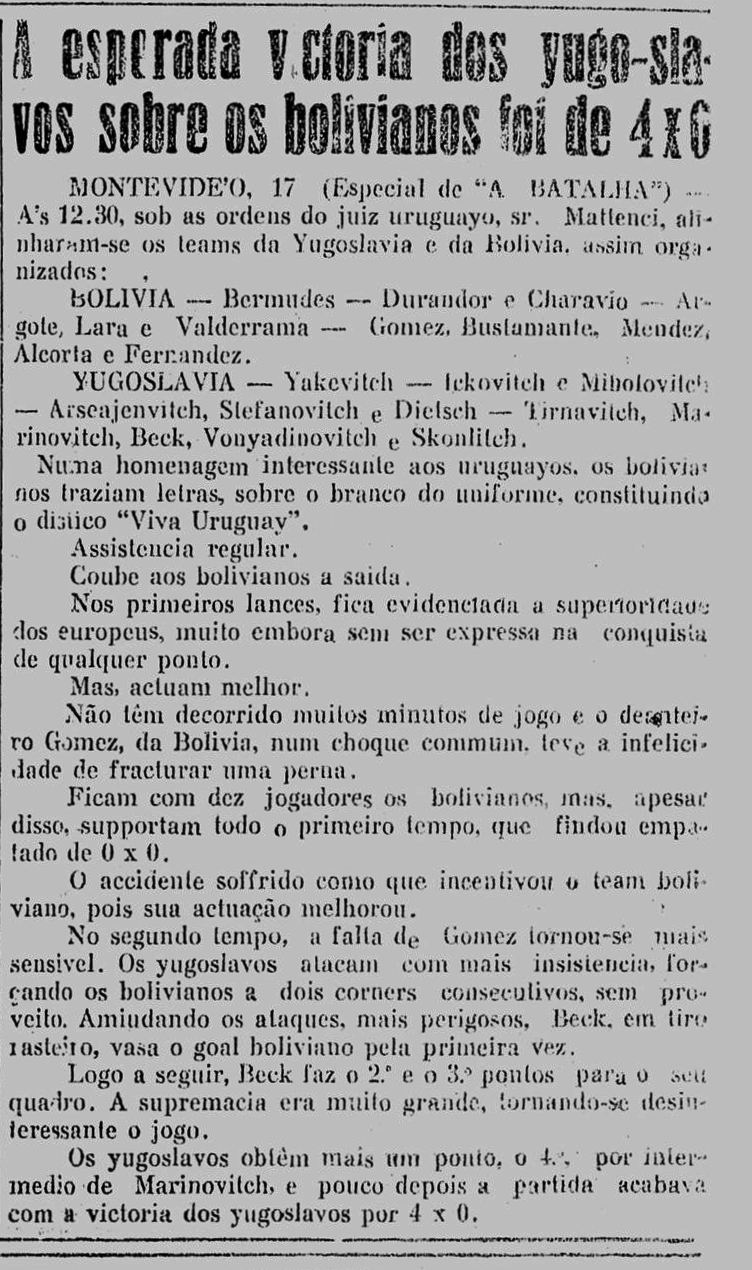
17 July 1930 - (World Cup Group 2) Yugoslavia v Bolivia (Match Report in A Batalha)

A Batalha, 18 July 1930.


This is a match report of the Yugoslavia versus Bolivia game that was played on the 17th July and was published in the 18th July publication of Brazilian newspaper A Batalha.

14 July 1930 - (World Cup Group 2) Yugoslavia v Brazil; (World Cup Group 3) Romania v Peru (Match Reports in El Heraldo de Madrid)

El Heraldo de Madrid, 15 July 1930

This article includes the match reports of the Yugoslavia versus Brazil (2-1) and Romania v Peru (3-1) games played on the same day, 14th July 1930, from the Spanish newspaper El Heraldo de Madrid.

Yugoslavia v Brazil (Match Report in A Batalha)

The front page of Brazilian newspaper, A Batalha, 15 July 1930.

This is the match report for the Yugoslavia versus Brazil game played on the 14th July 1930, recording the Brazilians shock 2-1 defeat to the Europeans. An interesting photograph that shows the multitude of Brazilian football fans gathering at the newspaper offices of the various Rio daily publications. Many of the newspapers would project speakers from their balconies informing the locals of up-to-date cablegrams coming in from Montevideo.

Saturday, 26 September 2015

1930 World Cup Newspapers and Magazines

Argentina's La Prensa reports the United States 3-0 victory over Paraguay. 18 July 1930
Argentina's La Nacion reports on the World Cup final, 31 July 1930
Belgrade newspaper reports on Yugoslavia's 2-1 victory against Brazil, Politika, 15 July 1930


Scenes from the World Cup, La Revista, Ano II, Number 83

A Noite, July 1930